
*****IF YOU WISH TO ORDER HARD COPIES OF OUR BOOKS, PLEASE VISIT https://livingjusticepress.org*****
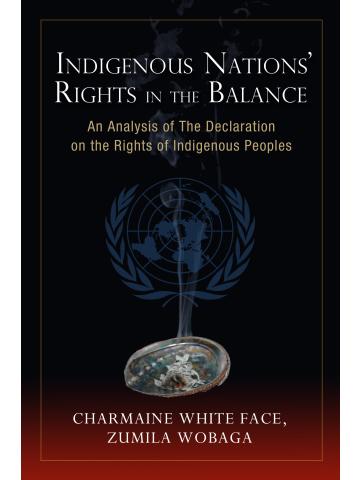
Comparing three different versions of the UN Declaration on the Rights of Indigenous Peoples (DRIP), Indigenous Nations' Rights in the Balance analyses the implications of the changes made to DRIP for Indigenous Peoples and Nations. This is a foundational text for Indigenous law and rights and the global struggle of Indigenous Peoples in the face of modern states.
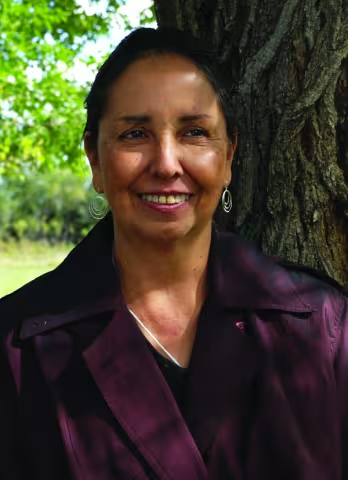
Between 1994 and 2007, three different versions of the Declaration on the Rights of Indigenous Peoples were passed by various bodies of the United Nations, culminating in the final version passed by the UN General Assembly. Significant differences exist between these versions—differences that deeply affect the position of all Indigenous Peoples in the world community. In Indigenous Nations’ Rights in the Balance, Charmaine White Face gives her well-researched comparative analysis of these versions. She puts side-by-side, for our consideration, passages that change the intent of the Declaration by privileging the power and jurisdiction of nation states over the rights of Indigenous Peoples. As Spokesperson representing the Sioux Nation Treaty Council in UN proceedings, she also gives her insights about each set of changes and their ultimate effect.
Praise for Indigenous Nations' Rights in the Balance
Elizabeth Cook-Lynn, Hunkpati Dakota
Author of A Separate Country: Postcoloniality and American Indian Nations
Charmaine White Face, a Lakota Wiyan from Pine Ridge, S.D., who is devoted to the political rights of indigenous peoples, gives us here a lucid and implacable analysis of the crucial relationship between Indians and their colonizers. Her work in Geneva, Switzerland, as well as her defense of the Black Hills of the North Plains region, challenges the United Nations Human Rights declaration of 2007 as deeply flawed. In examining the role of the UN, she charges that it has again through its recent declarations provided legitimacy and prestige not only to historical eighteenth-century genocide, but to the continuing plunder of rights and resources of native peoples. Her profoundly disturbing message forces us to ask the question: what happens when international law says powerful nations can use the idea of law as a weapon to gain consensus for theft? The so-called rule of law, as “discoverers” have shown us from the beginning, entrenches legal doctrines that justify genocide. The UN complicity, White Face tells us, has enormous consequences. No readers of this little text can dismiss the logic of her analysis if we are to learn the lessons of history.
Charmaine White Face is the Rachael Maddow of the Lakota political world concerning environmental and civil rights.... Her research is flawless. Her opinions are provocative and courageous and path breaking…. This is a good read.
David E. Wilkins, Lumbee
Co-author of Uneven Ground: American Indian Sovereignty and Federal Law
Charmaine White Face's mesmeric account of the Declaration painstakingly reveals the enormous difficulties that Native nations face in their quest to have their rights and resources respected by their host states and by the international community at large. The tortured process she described reveals that states interpret the phrase "rule of law" to mean "their rules and their laws," leaving indigenous peoples even now at the mercy of states and state-dominated institutions, like the U.N.
Duane Champagne, Turtle Mountain Band of Chippewa
Author ofCaptured Justice: Native Nations Under Public Law 280
Does the UN Declaration on the Rights of Indigenous Peoples actually protect indigenous rights? Charmaine White Face provides a series of powerful arguments and direct documentation that indigenous rights were passed over in favor of nation-state powers and jurisdiction over indigenous nations within nation states. Many indigenous organizations that participated in the long negotiations of the Declaration did not give their consent to the final UN versions of the Declaration. The final form of the declaration ignored indigenous self-government, rights to territory, plural citizenship, rights to appeal to international bodies for dispute resolution, and effective rights of informed consent. Instead of protection and articulation of indigenous rights, indigenous peoples are saddled with over 30 unenforceable mandates for nation states to include indigenous peoples as citizens within cultural, legal, and political orders of nation states. Indigenous peoples are willing to work with nation states, but not at the price of losing their indigenous rights to land, self-government, and cultural autonomy. This book provides a detailed analysis and evaluation that shows how nation states and the UN ignored the rights of indigenous peoples when finalizing the Declaration. Everyone interested in the well being of indigenous peoples should read this book.
Sharon Venne, Nehiyaw (Cree)
Lawyer
What a great piece of work—it is necessary for the people who were present to write the true history of the declaration and the gutting of the key language that we fought so hard to get into the original document. You have done the most amazing job. I am in awe of you and your work. It is the love of a woman for her people that you have undertaken this work for the future generations. We are in a long struggle to free ourselves. Indigenous Peoples must continue to push forward, as the ones not yet born are waiting for us to make a good place for them.